Martin Carthy – Frazer Theatre Knaresborough, Friday August 14 2015
Originally published in the Harrogate Advertiser/Knaresborough Post.
He might be one of British folk music’s most pivotal and best-loved figures – garlanded with an MBE and a Lifetime Achievement Award, his early influence on Bob Dylan and Paul Simon a matter of record – but at the age of 74, Martin Carthy wears his achievements lightly. In best troubadour tradition, he strolls up Kirkgate into Knaresborough town, guitars and suitcase in hand, ready to open this year’s FEVA festival with a solo show at the Frazer Theatre.
With no starry stage persona to project, and no signature songs to present for the umpteenth time, he opens with High Germany, the first track on his recently re-released 1965 debut album. Dating from the eighteenth century, it’s the first of several selections that deal with themes of war.
Ahead of each song, while he sets his guitar to a different tuning, we are given the context. The Doffing Mistress tells the tale of a group of mill girls who go on strike to support their sacked supervisor, one Elsie Thompson. While her charges have been bent double by their labours, Elsie can still stand up straight, hanging her coat on “the highest pin”.
The more we are told, the more meaning we can extract. For Carthy, this is a prime duty: the songs are what matter, and he is not here to distract us with showy dexterity or pretty frills. The playing is raw, unadorned, but full of character, invention and deft tricks of timing. He might forget a line here and there, shrugging off the blunder with an easy grin, but the picking never falters.
There are unorthodox tunings – he’s known for them – which twist new colours from his guitar. By keeping the bottom string tuned low, Carthy supplies his own bass section. On The Downfall Of Paris (“or The Downfall Of Pears, as it’s known in Dorset”), the effect is thrilling.
Some songs are as dark as any Nick Cave murder ballad. A jealous husband cross-dresses to trick his wife’s presumed lover, decapitates him, then learns too late that he is her secret bastard son. A battered wife stitches her sleeping husband into his bedclothes, then whacks him with a frying pan. Whoever said that folk music was twee?
He ends after two and a half spellbinding hours, with an acapella re-telling of Hamlet (“If you thought that was boring, you should read the bloody play!”) and a playfully creepy Harry Lime Theme. The cheers are hearty, sustained, and richly deserved.
Sleaford Mods: Key Markets
Originally published in LeftLion magazine.
 “I’m just a little moaning arse-fart, blowing smoke.” On an album which takes pot-shots at everyone from Cameron and Johnson to Brand and Blur, it only seems fair that Jason Williamson should turn on himself for a moment – but there’s more to Key Markets, the fifth Sleaford Mods album in three years, than mere scattergun abuse.
Lyrically more abstract than its predecessors, it’s also more varied in pace and mood, adding new colours to the palette. The opening two tracks, Live Tonight and No One’s Bothered, stick closest to what you’d expect – lairy chants, punk rock riffs – but elsewhere, we’re on shifting ground.
Silly Me nudges towards clumsy funk; Arabia wrong-foots you with awkward off-beats; Tarantula Deadly Cargo is a menacing, loose-limbed rumble, with an unfathomably surreal storyline. There’s seething rage on Face To Faces (“this daylight robbery is now so fucking hateful, it’s completely accepted by the vast majority”), but by the halfway mark on Side Two, Jason’s despair has taken a morose, almost defeated turn.
On the brooding, atmospheric Rupert’s Trousers, he takes weary aim at the Chipping Norton set, intoning mournfully over Andrew Fearn’s bleak, PiL-style dub tones. It’s followed by the staccato death-rattle of Giddy On The Ciggies, which gradually gathers steam, marshalling a final blast of fractured fury before ebbing away into hollow, wordless beats.
Hearteningly free of any concessions towards their new-found semi-fame (“we don’t want radio play, we’re not fucking Cannon and Ball”), Key Markets signals that Sleaford Mods are in for the long haul.
Pride Life cover feature: Madonna Magic
Originally published as a cover feature in Pride Life magazine.

Thirty years after Like A Virgin turned her into a global star, Madonna is still setting tongues wagging, flashbulbs popping and cash tills ringing – and yet, seven years since her last internationally chart-topping hit, her place at the top of pop’s ladder looks a good deal less secure.
This spring, with the release of her thirteenth studio album Rebel Heart, the 56 year-old is once again gearing up to claim centre stage as a relevant pop artist, whose glory days are far from over. It’s a game which almost all of her contemporaries have long since given up, and yet Madonna’s determination seems as fierce as ever. It’s a determination which has fuelled one of the most remarkable success stories of modern times.
 In contrast to the remote, quasi-regal position she now holds, safely sequestered behind superstardom’s velvet ropes, Madonna’s roots were grounded in club culture. Emerging from the cutting-edge Manhattan scene of the early Eighties, she scaled the dance charts before setting her sights on the Top Forty, using her club-savvy instincts to shape her sound and style.
It was a smart opening move, but this limited world was never going to contain Madonna for long. Doubtless mindful of the short shelf-life of most club-based acts, she wasted no time in trading dance chart credibility for mass pop appeal. Chic’s Nile Rodgers might have been her new producer, but Like A Virgin stepped firmly away from funkiness, shedding the egalitarianism of the dancefloor in favour of the nakedly ambitious individualism of the Reagan-Thatcher era. Madonna now wanted to be a star. She didn’t care who knew it, and she knew exactly how to get there. Material Girl, the album’s second hit, said it all: ironic and arch on one level, disarmingly sincere on another.
By the time of her third album, the staggeringly successful True Blue, any lingering traces of subversion had been snuffed out. The dream had been fulfilled. She was the stadium-filling darling of suburban Middle America, whose songs had ceased to say anything much beyond “where’s the party?” Granted, Papa Don’t Preach tackled the controversial subject of an unplanned pregnancy, but not in a way that would have disturbed a conservative mindset.
It still wasn’t enough. With commercial success now in the bag, Madonna re-booted her mission and embarked on a new journey: from ephemeral pop star to mature artist. Like A Prayer marked a thrilling re-invention, which seemed to expand the scope of what pop could achieve. Like the very best pop albums – the Thrillers, the Sgt. Peppers – it embraced a rich variety of genres, moods and themes, mixing the playful with the provocative, the sacred with the profane, and attracting the attention of heavyweight cultural commentators in the process. Madonna hadn’t been cool since her first and best movie, Desperately Seeking Susan. Suddenly, academics were falling over themselves to study her, high-end couturiers were clamouring to clothe her, and the world in general was starting to take her very seriously indeed.
From 1989 to 1992, Madonna ruled pop. The Immaculate Collection cherry-picked and subtly remixed her back catalogue, showcasing the gems and ditching the duds. To this day, it remains her biggest selling record. The Blonde Ambition tour scaled new heights of artistry and spectacle. Vogue conquered every dancefloor on the planet, its accompanying video oozing style and class. A fly-on-the-wall documentary, In Bed With Madonna, offered unprecedented levels of access to her private life, simultaneously bulldozing her mystique and building her brand. The Like A Prayer video drew accusations of blasphemy, the Justify My Love video was decried as soft-core pornography, and yet Madonna thrived on controversy, always ready with an eloquent defence. To most of us, it seemed as if she could do no wrong.
This period came to an abrupt end in October 1992, with the simultaneous release of Erotica (the single and the album) and Sex (the eye-popping coffee-table book). For many observers, Madonna had already pushed successfully at sexual boundaries – most recently with Justify My Love – and so it now felt as if she was boxing herself into a rather coarse and charmless corner. But for all this knee-jerk outrage (fuelled further by the teasing misdirection of some of its song titles: Why’s It So Hard, Deeper and Deeper, Secret Garden) the Erotica album turned out to be a surprisingly understated affair. More stylistically cohesive than its predecessor, it stands up well to the test of time.
Two years later, Madonna struck back. “Screw you, haters” songs might be commonplace these days, but with its defiant refusal to repent, Human Nature mapped out new territory. (“You punished me for telling you my fantasies, I’m breaking all the rules I didn’t make.”) Its parent album, Bedtime Stories, remains an under-appreciated piece of work. Warm, sensual and seductive, it supplied a ready-made soundtrack to countless nocturnal encounters. If you were ever invited back to a stranger’s room in the mid-Nineties, you would almost certainly have heard Bedtime Stories.
By Madonna’s standards, this was a lower-key release, paving the way for an extended break from the treadmill of pop. However, the singing lessons which she took for her screen portrayal of Eva Perón – the fulfilment of another long-held desire – stood her in good stead for the next reincarnation. Released in March 1998, Ray Of Light felt like an artistic rebirth, re-casting the go-getting sexual adventuress as a spiritually questing earth mother. Vocally, she adopted a fuller, more expressive tone, which matched the richness of William Orbit’s sumptuous, intricate arrangements. Lyrically, she offered her most personal collection of songs to date, openly questioning her former set of values, and striving for a deeper personal fulfilment. It was a triumphant comeback, selling more copies worldwide than Erotica and Bedtime Stories combined.
The winning streak continued with Music, an album whose mastery of diverse turn-of-the-millennium pop styles felt almost effortless. Perhaps uniquely for a pop star, Madonna had entered a second “imperial phase” (to use Neil Tennant’s memorable term), a full ten years after first peaking with Vogue. This renewed flush of globe-straddling success made what came next all the more shocking.
American Life was not an easy listen. Over jarring, jagged, minimal electronics, Madonna spat out her cynicism, rage, disillusionment and pain. The album’s mood was confrontational and claustrophobic, the gospel-tinged balladry of Nothing Fails its only moment of respite. You could admire the boldness of its execution, but it remained a difficult album to love.
If American Life had opened a window on Madonna’s darker side, then Confessions on a Dance Floor represented a move back into the light. With the assistance of producer Stuart Price, the erstwhile clubland queen reclaimed her crown, reminding us of one of her core strengths: the power to make us get down and boogie. Sequenced like a non-stop mixtape, with no drippy love songs to kill the buzz, the album felt both classic and contemporary: acknowledging Madonna’s pedigree, while placing her firmly in the here and now. For her long-standing gay audience, this was manna from heaven – but with many of her original gay fans now approaching clubbing retirement age, for how much longer could she rely on them to keep up?
Faced with the choice of either gracefully accepting her “heritage act” status, or of continuing to pitch herself as relevant to contemporary pop trends, Madonna opted for the latter. Equally significantly, as her marriage to Guy Ritchie began to crumble and her love affair with the UK began to wane, she turned back to the opposite side of the Atlantic for inspiration.
The result was Hard Candy, a collaboration with three major forces in R&B-slanted pop: Timbaland, Justin Timberlake and Pharrell Williams. For the first time, Madonna was chasing established stars, rather than giving a leg up to emerging talents. The album was efficient enough, giving her a massive international hit with 4 Minutes, but it was hard to shake off the suspicion that she was beginning to follow trends, rather than setting them.
The suspicion was compounded by MDNA, a half-hearted mish-mash of semi-digested dance-pop styles – EDM and dubstep among them – which is already starting to sound dated. With worldwide sales of around 4 million, Hard Candy had been the lowest selling studio album of Madonna’s career; four years later, MDMA managed to halve that figure. Too trend-driven to retain an older audience, and too out-of-touch to win a younger one, it fell between demographic stools.
A more satisfactory balance has been struck on the latest album, Rebel Heart. As its title implies, Madonna’s outspoken and romantic sides are equally accommodated, from Holy Water’s shrill “bitch, get off my pole!” to Inside Out’s tender “let me solve your mysteries”. There’s less desperate bandwagon-chasing this time around; instead, the songs are sturdier, and the singing comes from a more honest place. She may never again enjoy a period of absolute global rule, but as a tireless striver, dogged survivor and unrepentant provocateur, Madonna still has no equal.

Madonna in the 1980s.
HIT: Like A Prayer – the song which elevated Madonna from “pop star” to “artist”.
MISS: Causing A Commotion – a pale, trite attempt to recapture the glories of Into The Groove.
Madonna in the 1990s.
HIT: Take A Bow – if Bedtime Stories was one long seduction, this deceptively sweet-sounding kiss-off was the bitter sting in its tail.
MISS: Little Star – a sickly lullaby to baby Lourdes, which tells her to “never forget who you are” – as if such a thing were possible?
Madonna in the 2000s.
HIT: Hung Up – boosted by a killer Abba riff, it re-crowned her as queen of the dancefloor.
MISS: Die Another Day – given the chance to craft a classic Bond theme, she flunked it with this jagged, jarring hodge-podge.
Madonna in the 2010s.
HIT: Joan Of Arc – sounding more emotionally engaged than she has done in years, Madonna gives us a rare glimpse of her vulnerable side.
MISS: Superstar – a clod-hopping, lyrically inane rip of I Gotta Feeling, which already felt two years too late.
Pride Life: Disco Kicks
Originally published in Pride Life magazine.

Over thirty-five years after the music industry tried to declare it dead, disco remains the genre that refuses to go away. Take this year, for instance. There are new releases from Chic and Giorgio Moroder, two of disco’s greatest practitioners. The early work of Grace Jones is being reappraised, thanks to a comprehensive boxed set, The Disco Years. Jimi Somerville, arguably the first big-selling artist to revive the genre in the first place, has returned to disco with his latest album, Homage. To the delight of the crate-digging cognoscenti, the legendary French disco producer Cerrone is making his Glastonbury debut. At the Berlin Film Festival, a radically revised director’s cut of Studio 54 wowed the critics. Meanwhile, Seventies-inspired looks have been a major story in many of this year’s spring/summer fashion collections. Once derided by rock fans for its superficiality, and sniggered at by style snobs for its excess, disco has been enjoying the last laugh ever since.
The movement’s roots stretch back to east coast America in the early Seventies, and an unlikely collision between seemingly disconnected underground scenes. Emerging from decades of oppression, and now openly striving for both personal and political liberation, a new generation of gay men were finding salvation every weekend on the dance floor, as documented by writers such as Andrew Holleran (Dancer from the Dance) and Edmund White (States of Desire). Elsewhere in the same urban centres, a similar new mood of confidence and optimism was re-shaping black culture, soundtracked by a smoother, more luxuriant take on soul music that found its perfect vehicle in the richly orchestrated Philadelphia sound (and equally eager audiences in working class Italian-American and Latino communities). Add the lingering influences of post-psychedelic drug culture into the mix, sprinkle with bohemians, fashionistas, artists, dealers, hookers, slumming high-lifers and hustling low-lifers, and you have a unique melting pot that would soon bubble over from the underground to the mainstream.
By the time that the Saturday Night Fever phenomenon had repackaged disco culture for the masses (an unlikely development, given the gritty, glamour-puncturing nature of the film itself), there were dance clubs in every town in the Western world, where dolled-up suburbanites shimmied to the Bee Gees, entirely unaware of the subcultures which had spawned their weekend rituals. Disco had become big business, and record companies and radio stations fuelled the glut. Rock superstars, showbiz legends and new wave upstarts alike jumped on the bandwagon, with results ranging from the sublime (Blondie’s Heart Of Glass, The Rolling Stones’ Miss You) to the ridiculous (Rod Stewart’s Da Ya Think I’m Sexy, the unspeakable horror of Ethel Merman’s Disco Album).
A backlash had become inevitable, and nowhere did it strike more sharply than in disco’s homeland, the USA. In July 1979, just as the music was reaching its highest commercial peak, a “Disco Demolition Night” in a Chicago baseball stadium, where piles of disco records were literally exploded on the pitch, turned into a riot, making national headlines and coining a new slogan: “disco sucks”. Chastened by the wrath of the rock fans, the American music industry beat a hasty retreat. The Knack’s My Sharona replaced Chic’s Good Times at the top of the Billboard chart, and by the autumn of that year, “disco” had become a dirty word. Collars, lapels and trouser legs all shrank, bouffants were trimmed and shirt buttons were re-fastened over chests, as the Eighties loomed into view.
Over here in Europe, where nobody quite got the “disco sucks” memo, the genre was permitted a more graceful decline. The melting pot fragmented once again, as smaller scenes re-grouped. A dedicated soul/funk crowd continued to carry the torch for the cooler, less hyped-up end of the spectrum, while disco’s zingier, sparklier side became more expressly linked with gay dancefloors, re-emerging a couple of years later as hi-NRG. Meanwhile, Shalamar, Kool and the Gang and Odyssey all enjoyed respectable hit-making careers, regardless of whether anyone called them “disco” or not, and continental summer holidays continued to be soundtracked by the brash and breezy strains of Euro-disco.
Other legacies were also brewing. In one corner, there was hip hop: disco’s bastard offspring, quietly biding its time. In another, even tinier corner, a group of black and gay Chicago DJs were keeping the faith, preparing the way for the house music explosion – or “disco’s revenge”, as some commentators wisely put it.
There were wider and equally enduring legacies, too. Disco had introduced us to the art of seamless beat-mixing, and the pleasures of dancing until dawn in a darkened room, whether chemically assisted or not. And it had given the world a new breed of performer: the glamorous dance diva, defiantly masking her pain, and giving a soulful voice to our joys and sorrows, our dreams and our desires. The genre itself might have dipped in and out of style over the years (although we never seem to be more than a few years away from its next revival), but most of its key elements – dressing to impress on a Saturday night, the communal ritual of the dance floor, the craft of the DJ, door policies, velvet ropes, lasers, smoke machines, and that biggest totem of them all, the hallowed mirror ball – will probably always be with us.
TEN ALL-TIME DISCO CLASSICS
Boogie Oogie Oogie – A Taste Of Honey
Don’t Leave Me This Way – Thelma Houston
Everybody Dance – Chic
Never Can Say Goodbye – Gloria Gaynor
On The Radio – Donna Summer
Shame – Evelyn “Champagne” King
The Boss – Diana Ross
Turn The Beat Around – Vicki Sue Robinson
Vertigo/Relight My Fire – Dan Hartman
You Make Me Feel (Mighty Real) – Sylvester
TEN DISCO CRATE-DIGGERS’ CULT CUTS
Ain’t No Mountain High Enough (The Garage Version) – Inner Life
Change – Zulema
Dancer – Gino Soccio
Haven’t You Heard – Patrice Rushen
I Know You, I Live You – Chaka Khan
Law Of The Land – The Temptations
Souveniers – Voyage
Take Off – Harlow
Tell You (Today) – Loose Joints
The Hills Of Katmandu – Tantra

Pride Life: Pops Picked
Originally published in Pride Life magazine.

From synthpop to soul, Mike Atkinson picks some of the hottest talent you’ll be hearing a lot more of this year.
The latest in a long line of synthpop duos, stretching all the way back to Soft Cell and Yazoo, April Towers have a knack for constructing sturdily chugging, instantly danceable songs which surge into soaring, hooky choruses. Rhythmically similar to New Order, melodically reminiscent of OMD and vocally akin to Depeche Mode, they take classic influences and embellish them with a contemporary twist, placing them alongside the likes of Hot Chip and Hurts. Having made their live debut just over a year ago, long-time friends Charles Burley and Alexander Noble have already released two singles this year: the elegantly remorseful Arcadia and the insistently throbbing No Corruption.
For fans of: New Order, OMD, Hurts.
Comprised of twin sisters Paris and Amber Strother and their friend Anita Bias, the always-to-be-capitalised KING (no relation to the mid-Eighties hitmakers!) specialise in classic neo-soul, adorned with rich three-part harmonies. There’s a smooth sophistication to their music which bears comparison with Erykah Badu and Jill Scott in their Nineties heyday – and indeed, Badu herself has already lent them her support. Following last year’s well-received single Mister Chameleon, a wry take on “fair-weather love”, the trio are preparing to release their self-written and self-produced debut album, We Are KING. As performers, they are imbued with a graceful warmth and an easy charm that makes light of their musical prowess.
For fans of: Erykah Badu, Jill Scott, Angie Stone.
Blessed with a voice of exceptional purity and clarity, with a singer-songwriter’s emotional sincerity and a jazz performer’s subtlety of tone, Laura Groves has remained a well-kept secret for too long. This could all change soon, with a new EP, Committed Language, and some high-profile support sets with Elbow, which have been arranged at the band’s specific request. This is delicate, intimate and contemplative music, skilfully arranged but delightfully unshowy. Originally from Bradford, Laura first performed as Blue Roses, before moving to London and working under her own name. Her fascination with the blurred boundaries between dreams and reality informs much of her work, lending it an other-worldly quality.
For fans of: Joni Mitchell, Donald Fagen, Kate Bush.
Channelling the energy of vintage funk (Parliament, Stevie Wonder, Prince) and filtering it through “a cement-coloured North of England lens”, Mancunian singer and multi-instrumentalist Julie Campbell, aka LoneLady, is back after a four-year break with her second album, Hinterland. Recorded at home on an 8-track cassette recorder, with production completed in a remote vintage analogue studio in Michigan, the nervy post-punk influences of her earlier work are still there, but they’re now sweetened with a more dance-infused approach; recent single Groove It Out explores similar territory to La Roux’s most recent work, while Bunkerpop chugs along like a distant cousin of the Eurythmics evergreen, Sisters Are Doin’ It For Themselves.
For fans of: La Roux, St. Vincent, Imogen Heap.
Already basking in critical acclaim on both sides of the Atlantic, the debut album from Nashville’s Natalie Prass could end up as one of this year’s stealthy word-of-mouth successes. It’s a break-up record at heart, but delivered with a swooning sweetness that masks much of the underlying pain. “Where do you go, when the only home that you know is with a stranger?” she asks on the opening track (My Baby Don’t Understand Me), concluding that “our love is a long goodbye”. Widely compared to Dusty In Memphis, the music harks back to classic country-soul, sung with captivating tenderness and orchestrated with Hollywood strings and Muscle Shoals horns.
For fans of: Dusty Springfield, Laura Marling, Feist.
Shamir
Raised in semi-rural North Las Vegas, Shamir Bailey started his musical journey with acoustic country and folk music, before making a late teenage detour into punk rock. Now aged 20, he is beginning to make his name as a pop performer, drawing on dance, funk and rap influences, and creating something characterful and unique. Inspired equally by Nina Simone, Joanna Newsom and The Slits, his intentionally androgynous vocals are showcased on If It Wasn’t True, a funky Prince-goes-house jam, while on On The Regular, his most recent release, playful rap sits on top of bouncy, fresh-faced, sugar-rush pop. It’s not all madcap hyperactivity, though; Shamir can also work a lovelorn lament, with yearning conviction.
For fans of: Prince, Jungle, Azealia Banks.
Cantaloupe – Zoetrope
Originally published in LeftLion magazine.
 In the three years since Souvaris played their farewell gig, three of its former members have forged a new path as Cantaloupe, developing a brighter, sunnier, more synth-based retro-futurist sound. On this, their debut album as a trio, we find them steering away from the tricky time signatures of old, and heading towards a more streamlined approach.
In another break from tradition, vocalists have been enlisted on three tracks. (One of them, Eleanor Lee, has since joined the full-time line-up.) But although it’s interesting to hear the band shaping their arrangements around traditional song structures (with stylistic nods towards Stereoloab, Chromeo and Broadcast), it’s on the instrumental cuts that Cantaloupe’s unique qualities fully come into their own.
On Big Kiss and Ian Whitehead, which open and close the album, they’re at their most assertively optimistic, as primary coloured, shape-shifting blocks of sound shimmer, clatter and rumble, evoking memories of late Sixties/early Seventies TV themes or public information films.
Named after a dodgy Nineties chatline, 0891 50 50 50 offers a thrilling excursion into early Eighties Hi-NRG and electro-funk, slapping a Bobby Orlando donk under Patrick Cowley synths. Placed at the start of Side Two, it’s the album’s most overtly dancefloor-friendly moment.
Between these energy peaks, the mood dips into calmer waters, but without ever losing that core sense of restless forward motion; in Cantaloupe’s world, nothing stays still for long, and there’s always a new twist waiting around the corner. Intricate and complex, yet instant and accessible, Zoetrope radiates joy and wonder throughout.
Interview feature: Indiana
Originally published in Pride Life magazine.

A few years ago, Indiana found herself with an upright piano, left for storage by her sister. Undeterred by lack of training, she taught herself to play, uploading home-made clips to YouTube. A moody, stripped down cover of Joe Goddard’s club hit Gabriel attracted the attention of its composer, John Beck, and the pair started collaborating. In April 2012, the singer made her live début, gaining instant acclaim for her emotionally charged brand of leftfield electronic pop.
Just over a year later, Indiana performed David Bowie’s Heroes in front of the Queen, in Radio One’s Live Lounge. Since the song contained the potentially treasonous line “I will be Queen”, its lyrics needed prior vetting – to “Queen-proof it”, as she puts it.
“First of all, her people said: we’re going to make her change the words. Then they spoke to the Queen, and she said: no, it’s fine, just don’t look at me. The thing is, I was so conscious not to look at her, that my eyes were darting round the room, and they hit her a couple of times. So I did actually look at her when I sang the line!”
Earlier this year, Indiana charted with Solo Dancing, whose video was stuffed with visual puns for more intimate types of solo activity. (Beans were flicked, chains were yanked, cats were stroked: you get the picture.) “I go dancing by myself, I go dancing with no one else”, she sang, over a steadily throbbing synth pulse.
“The song is about empowerment”, she says. “It can be a metaphor for anything: to be comfortable in your own skin, and to be able to do something on your own.” For a gay audience, the song could be taken more literally; after all, many of us are no strangers to lone-wolfing it on the dancefloor. “I’d love to have the confidence to go out dancing on my own”, she admits. “I think that whoever’s got the balls to do that, has got the biggest balls!”
No stranger to the gay scene herself, Indiana was introduced to the bars and clubs of Brighton by her late uncle. “He was also a music producer. And on his deathbed, he said to my sister, who was into music – singing, piano lessons, gigging, writing, everything – ‘you’d better watch her, because she’s going to be nipping on your heels’. I didn’t even realise I wanted to be a musician then. So he always knew that I had something in me.”
In the video for current single Heart On Fire, Indiana stars alongside Charlie Bewley, best known for playing the vampire Demetri in the Twilight Saga series. (“He’s the director’s friend, so I got him for a steal.”) As the story unfolds, we see her “acting like a sweet girl, whereas I am in fact a powerful woman in a powerful position”. By the end of the video, she is revealed as an undercover drug enforcement officer, who has persuaded Bewley to set up his dealer friend in a sting operation. The theme of the story – that all is not what it seems – is explored further on Indiana’s début album, No Romeo.
“On the surface, the songs could be interpreted as love songs or just pop songs, but if you delve a little deeper, each one has a meaning that’s more sinister. Each time I write, I always have to have, for some reason, a sinister take on everything.”
Unlike Shakespeare’s Romeo, who finds true love but is ultimately destroyed by it, Indiana finds only tainted love, and yet she survives. Even at her most vengeful – “all your sons and daughters will be broken, from now on and ever more”, she pledges on Never Born, the opening track – you sense an underlying vulnerability, and even in her most vulnerable moments, her core strength never fully deserts her. On Bound, she uses S&M imagery to trace a journey from submission to dominance (“this isn’t love, this is dangerous”), while on the album’s title track, she spurns the whole idea of romantic love: “I don’t need no Romeo… it’s not enough, it’s alright, but I’m sleeping on my own tonight”.
A happily settled mother of two in real life, Indiana warns against interpreting her songs too literally. “They’re not all necessarily about relationships”, she suggests. “I like to tell stories, but I do draw on experiences and refer to them in songs.” In conversation, she is cheerful, straightforward, and quick to laugh, but any suggestion that “Indiana” is an invented persona is firmly rebuffed.
“I don’t feel I have to step into any shoes. I create songs to say things I never would, but I am Indiana. My mum says I have an interview voice. She says I sound more sensible, whereas in my own environment, I am a whirlwind of things going on inside my head. My dark side is channelled into my music, and I’m thankful that I have my music, so that I’m not out on killing sprees!”
Sleaford Mods & Kagoule – Nottingham Rescue Rooms, Tuesday January 27.
Originally written for LeftLion.
Kagoule as the support, eh? Aargh, just my luck. The last time I saw them play – Lacehouse basement, December 2013, an “in the round” set which placed us inches from their speakers – the experience left my ears ringing for weeks. Since then – and please, I mean to cast no slurs upon Kagoule’s art – I’ve not been able to hear them without suffering some sort of psychosomatic relapse. Yeah, it’s been an issue.
They start with Monarchy, their oldest song. Singer/guitarist Cai Burns wrote it five years ago, aged fourteen. A couple of years later, the trio broke through with the uncharacteristically lilting Made of Concrete, won a contest to play Rock City, and signed to Denizen. For a while, they seemed shackled to another new band, Kappa Gamma: similar age, same Rock City contest, same label, even the same initial letters. Kappa Gamma have since dipped from view, but Kagoule have been slowly stepping up. They’re on Earache now, and Gush, their debut single for the label, came out at the end of last year.
They may not be as noisy as the average Earache act, but Kagoule are still a good fit. For a teenage act, they’re more in thrall than most to the alt-rock boom of over twenty years ago – Fugazi, Unwound, the Pumpkins – so their place on the veteran label’s roster somehow underlines that lineage.
I’ve seen this band many times over the past few years. They’re less doleful these days, and they’ve grown bolder, spikier, more sardonic. The newer songs take more twists and turns. I was expecting them to have grown heavier and doomier, but mercifully that hasn’t happened. We only need one Swans.
They still play Made of Concrete, Lawrence English is still an uncommonly fine drummer – the glue that binds the band together – and bassist Lucy Hatter still has that song where she sheds her mask of inscrutability and starts screaming seven shades of hell. They’ve played stronger sets than this – Lucy has monitor problems, Cai vows never to use his guitar again – but on a big night at a sold-out Rescue Rooms, they feel like the right band at the right time.
It’s been nearly two years since I last saw Sleaford Mods: upstairs at the same venue, supporting I Am Lono, their second album as a duo (Austerity Dogs) just out. A few months earlier (to re-phrase John Cooper Clarke, an act they are often compared to but sound nothing like), its predecessor (Wank) had soured the mood of the newly self-celebratory Nottingham music scene like a fart at a birthday party. Whether born of righteous outrage or plain old trolling, its parochial pot-shots hit the mark, finding favour on the fringes and – against the odds – drawing the duo towards the spotlight, pariahs no more.
Side Two of Austerity Dogs was more or less a vinyl reissue of Wank, but with Side One, you sensed a widening of the net, a broadening of the scope, and a gathering focus for the fury. Jason Williamson had been ranting over loops on tiny stages for years, but Andrew Fearn’s arrival added vital new ingredients: a shared mindset, the right beats, the perfect onstage foil.
Two years, two more albums, countless limited edition singles, hundreds of gigs, an unexpectedly devoted pan-European fanbase, a hardback book, reams of column inches, a Guardian editorial, a fistful of placings on year-end critics’ lists and a smattering of press spats with UK rock royalty later, the Mods have returned in triumph, selling out the Rescue Rooms and earning a heroes’ welcome – however belated some of those welcomes might be.
Their return might be triumphant, but it’s anything but triumphalist. If anything, Williamson looks nervier these days: his movements more staccato, his demeanour less arrogant hard-man, his stage positioning more side-angled than head-on. Has all this acclaim humbled him? It’s a viable possibility.
He has developed a new tic, constantly flicking the back of his head in a singular, changeless manoeuvre. There are other tics, more sparingly deployed: puckered kisses, cheeky tit-squeezes, belly-flashing shirt-flicks, regal waves to the gallery. They ape the moves of a narcissistic rock star, but with an off-kilter, truncated timing that renders them as arch performance art. Beside him, Fearn does his usual: pressing play on a stool-mounted laptop, chugging bottled lagers, grinning, shuffling, mouthing along with key lines, the Yang to Jason’s Yin.
They’re on for exactly an hour, counting the encore. I’m told the atmosphere is less intense than at the last headline show at Spankys. Barring a few diehards down the front, this set of punters remains largely stock still, but they’re no less appreciative. A lot of scenester faces from, ahem, “back in the day” are here, dotted around the edges. Better late than never, right?
They open with Bunch of Cunts, from the latest EP. As opening salvos go, it couldn’t be more perfect. The energy levels rise for Jolly Fucker (“elitist hippies, arrogant cunts, Ian Beale tight trunks”), and they rise again for McFlurry (“I got a Brit Award! I got a Brit Award!”). By the time we get to the double sucker punch of Jobseeker and Tied Up In Nottz (“Hello Derby!”), the room is on fire.
Unlike their recorded versions, tracks have a habit of ending with repeated chants. “Smash the fucking windows!” brings Tied Up In Nottz to its climax, and “sack the fucking manager!” shuts Fizzy down. Dedicated to managers everywhere, Fizzy hits a special nerve. Most of us have worked for a “cunt with the gut and the Buzz Lightyear haircut, calling all the workers plebs”, and so has Jason – until a few months ago, when his rising fortunes as a Sleaford Mod enabled him to quit his day job with the council. It must have been the sweetest of victories.
Doubtless mindful of his captive audience, Jason gets Andrew to cue up an unscheduled track from Wank. Inspired by LeftLion’s 2011 music scene cover shoot at Rock City, Showboat blasts the hometown posers and careerists. “I heard the rule was: move to London. I heard the monkeys get the train. I ain’t a showboat, but you are, and I’ll die laughing my tits off in your face.” It’s the nearest we get to a “how d’you like me now, suckers?” moment.
Pubic Hair Ltd deals another kiss-off, this time to the Wellers and Gallaghers of this world. “Who gives a fuck about yesterday’s heroes… it’s not a pyramid, you’re not a fucking Pharaoh.” The Wage Don’t Fit closes the main set, then they’re back for three more. Fearn hands one of his beers to the front row, and Tweet Tweet Tweet ends the hour on the highest of highs.
Rock City next, then? There seems no reason not to.
Set list: Bunch of Cunts, Middle Men, Jolly Fucker, A Little Ditty, McFlurry, The Demon, Jobseeker, Tied Up in Nottz, Routine Dean, Tiswas, Fizzy, Under the Plastic and N.C.T., Showboat, Pubic Hair Ltd, The Wage Don’t Fit, 6 Horsemen (The Brixtons), Five Pound Sixty, Tweet Tweet Tweet.
Album review: Indiana – No Romeo.
Originally published in LeftLion magazine.
 “These may appear to be love songs but look closer, chip away their exterior beauty and reveal an inner darkness. I am No Romeo.” With these words, Indiana defines the central theme of her début album, which folds twisted takes on love, loss, betrayal, revenge and regret into sinister, icy, leftfield electronic pop.
Unlike Shakespeare’s Romeo, who finds true love but is ultimately destroyed by it, Indiana finds only tainted love, and yet she survives. Even at her most vengeful – “all your sons and daughters will be broken, from now on and ever more”, she pledges on Never Born, the opening track – you sense an underlying vulnerability, and even in her most vulnerable moments, her power never fully fades.
On the cavernous, gothic Play Dead, she could be Juliet, feigning death as a coping strategy. On Bound, she traces a journey from submission to dominance in a way that hints at sado-masochism (“this isn’t love, this is dangerous”), while on the title track, she spurns the whole idea of romantic love: “I don’t need no Romeo… it’s not enough, but it’s alright, I’m sleeping on my own tonight”.
Only The Lonely buries an uplifting dance anthem under six feet of soil; Heart On Fire subverts the headrush of falling in love, casting it as a perilous act, like jumping off a tall building. Finally, Mess Around ends the journey with a ghoulish resurrection and a deadly re-embrace: “Your suffering completes me, I’ll take no more, I want no less.”
The Guardian gig venue guide: The Bodega, Nottingham
This tiny room with perfect sound and a clued-up crowd has a track record of spotting some of the best up-and-coming bands – including the Strokes, White Stripes, Coldplay, Arctic Monkeys, Scissor Sisters.
Capacity: 250
Who plays there: The Bodega has a remarkable knack for catching acts before they make it big: the Strokes, White Stripes, Coldplay, Arctic Monkeys, Scissor Sisters, Bloc Party, the Libertines, MGMT, the National, Mumford & Sons, Snow Patrol and Haim, Clean Bandit and the 1975 have all played here. The run-up to Christmas this year brings Eagulls, Circa Waves, Thurston Moore, Marika Hackman and many more. There are several shows a week.
Hockley Hustle – Nottingham, Sunday October 19
Originally written for LeftLion.
If the Hockley Hustle was Glastonbury, Nottingham Contemporary would be its Pyramid Stage. Dean Jackson and the BBC Introducing team have bagged a cracking line-up – including Harleighblu, Amber Run, Georgie and The Gorgeous Chans – and even at the start of the day, I find myself suppressing a rogue urge to park my lazy arse in The Space for the duration.
My Hustle odyssey duly begins here, with a long-awaited first chance to witness April Towers, a synth-pop duo who variously remind our little group of OMD, New Order and Hurts. April Towers have a knack for constructing sturdily chugging, dance-friendly tracks which surge into soaring, hooky choruses – not least on Arcadia, their imminent début single. All they need now are a couple of numbers which offer more of a contrast, in terms of rhythm and tempo.
There’s another strong bill at Antenna, at the opposite end of the festival. It’s a fair old trudge, but as my Glastonbury-hardened pals point out, it’s a mere stroll when compared to the trek between the Pyramid and Other stages. We’re here to see Ashmore, backed by his new band Unknown Era, but we also manage to catch the end of Captain Dangerous’s set; they’ll be performing again at the JamCafé later on.
The atmosphere at Antenna feels a bit weird: more like a TV studio than a gig venue, and focussed more on the Notts TV cameras than the seated audience behind them. The stage is hosted by Al Needham, who has been shunted onto a sofa in a far-flung corner, his introductions and interviews performed to cameras instead of punters. During his interview with Captain Dangerous, clipboard-wielding apparatchiks stalk the floor, shushing anyone who talks above a whisper. During Ashmore’s set, our view is obscured by a central column, and by a camera crew whose wheeled rig constantly trundles back and forth at the front of the stage. Still, the images on the monitor screens look most professional, and the event is sure to make good TV viewing.
In a departure from the gypsy jazz-tinged acoustic hip hop which first made his name, Ashmore’s sound has been fleshed out by the addition of electric guitars, bass and cajón, adding rock’s wallop and reggae’s lilt to familiar songs such as Misfit and My Town. It’s a bold step forward, and a successful one at that.
Signing ourselves out of Antenna – yes, there’s a little book on reception, even today – we emerge into an unexpected shower. With a spare thirty minutes before the next act on our list, we head for the main drag with open minds, ready to dive for shelter in any venue with music emerging from its doors. This does not prove to be an easy mission, as everywhere seems to be in turnaround, preparing for the next act at the top of the hour.
Help arrives on the corner of Stoney Street, as a group of friends on a smoke break usher us into The Corner, where I’m Not From London’s stage is already in full flow, blessed by a packed house. The band are “like Nirvana, but without a singer”, we are promised. “So, the Foo Fighters then?” we quip.
They turn out to be a bracingly intense instrumental trio, with the drummer marooned on stage and the guitarist and bassist lurching about on the main floor. Given the volume level, it takes me a while to establish their name. “Did you say Jay-Z The Pope?” “No, it’s like the bus stops.” “Bus Stop Madonnas? But this lot are blokes!” “I’ll write it down for you.” Oh, JC Decaux. Thank you. The atmosphere here is fantastic, but we have to move on.
In the dank basement of Bambuu, DH Lawrence & the Vaudeville Skiffle Show are the venue’s first live act at the day, over an hour earlier than the printed programme and on a different floor. This probably accounts for the somewhat sparse turn-out – the band themselves claim to recognise almost everyone in attendance – but a relaxed, jokey vibe prevails. The music is equal parts skiffle and bluegrass, with banjos, washboards, big hats, and our second cajón of the day. In a tribute to the band’s Eastwood forefather, Sons and Lovers sets passages from Lawrence’s classic novel to music. We emerge from the gloom with big smiles on our faces.
It’s one out, one in for Josh Wheatley at Boilermaker. With a dozen people ahead of us, we cut our losses and retreat. Where next? Bus Stop Madonnas are due on any minute at The Music Exchange, so we browse the racks and then take the afternoon air, to the strains of a busking duo covering Katy Perry. The expected few minutes stretch into half an hour – the first of several such delays – but we stand firm.
They’re worth the wait, of course. It’s a strange thing, watching rowdy, primitive, spirit-of-77 punk rock from all of three feet away, while an equal number of spectators cluster outside the shop window; clearly, the squall has no problems transmitting through glass. As all persons of taste should be aware, spirit-of-77 punk rock is one of the greatest genres known to humankind, and the two Madonnas serve it up with spirit and aplomb.
Dragging a couple of jazz fans with us, who have been enjoying the bill at Das Kino, we head back to Contemporary for Gallery 47. The last time I saw Jack Peachey perform, he was battling against chatty half-listeners at Jamcafé; this time around, he is blessed with absolute and total attention, from a hearteningly full room.
Doubtless bolstered by his recent European support slots with Paul Weller, Jack steps up to the demands of the larger space, projecting his performance without surrendering its core intimacy. Halfway through the set, he ditches his song list, ceremoniously handing it into the audience, and opts to play whatever takes his fancy. This includes a clutch of unreleased new songs, easily the equals of anything on his current album, and a beautifully understated rendition of All It Could Grow Up To Be, a personal favourite.
Within the prevailing “keep it positive” constraints of Notts music journalism, rave reviews are in danger of becoming devalued currency – but this was simply the finest Gallery 47 set I’ve seen to date, and my artistic highlight of the day. The jazz fans, who had never heard of him before, were mightily impressed; they can’t have been the only instant converts, either.
Time for a complete change of scene. Nirvana and Revolution are the places to be for hip hop and grime, so we descend upon a heaving Revolution, where rap battle league Don’t Flop will be filming the ultimate hometown clash: Youthoracle vs. Bru-C. First brought forward an hour, the battle is then delayed by half an hour. My friends lose patience and peel away – one to Band Of Jackals and the other to 94 Gunships (both reportedly excellent) – but having covered the big Don’t Flop event at the Rescue Rooms earlier in the year for The Guardian, there’s no way that I’m missing this local derby.
They may be the best of friends in real life, but Youth and Bru go in hard against each other. Bru-C mocks his opponent for his nu-metal past and a suspicious fondness for Classic FM; in turn, Youthoracle derides Bru-C’s indie hipster cred and his “relaxed high-top” haircut, and teases him for choking at the Rescue Rooms event. Hush in the room for the unamplified set is hard-won, but the local crowd lap up all the in-jokes and Notts-specific references, roaring their appreciation for the many killer punches. Youthoracle narrowly wins the trophy – but in truth, these were classic, precision-honed, top-of-their-game performances from both MCs alike.
It’s an easy stumble over the road to the LeftLion stage in the Broadway bar, where twinkly soul showman Rob Green is, as ever, charm personified. With a new band and a new set list, he’s on fine form, spreading good vibes across the room. I haven’t seen much dancing until now, but folk are eagerly getting their groove on, and it’s a pleasure to behold.
My middle-aged feet can only take one more act, and that act has to be the newly rebranded, deceased-canine-no-longer D.I.D, back in the reassuring comfort of the Contemporary. Like Rob Green before them, the band play a mostly all-new set, with Two Devils and a concluding Teenage Daughter thrown in as crowd-pleasers. Apart from the greasy blues-rock riff which powers one of the new songs, which will be made available for general consumption very soon, no especially radical re-inventions are unleashed. Instead, we are offered a refinement of the classic D.I.D sound – but it’s no mere rehash, either. The material is strong, well-crafted and instantly appealing, and it all bodes well for the next chapter in the band’s career.
The feet are screaming for relief, and so the odyssey comes to an end. It’s been an extraordinary day: rich in musical diversity and strong on collective goodwill, and all in the name of several charitable good causes. Everyone involved in the planning, promoting, staging and delivery of the event should take immense pride in their achievement.
Kiki Dee & Carmelo Luggeri: An Acoustic Journey.
Knaresborough Frazer Theatre, Saturday October 25.
Originally published in the Harrogate Advertiser / Knaresborough Post.
Internationally successful chart-toppers aren’t exactly queuing up to perform in Knaresborough, to put it mildly. But although it’s a long way from Madison Square Garden and Live Aid to the 130-capacity Frazer Theatre, Kiki Dee and her long-standing musical partner Carmelo Luggeri have grown fond of the venue; by their reckoning, this is their third visit. “There’s a warm atmosphere here, isn’t there?”, Kiki remarks. “That’s because we can’t turn the heating off!”, someone calls back.
At this stage in her career, with over fifty years in the business behind her, Kiki could be playing it safe on the concert hall circuit: all the hits as we remember them, safe cover versions, maybe a Classic Love Songs collection or two, surrendering artistic evolution for “heritage act” comfort. But that’s just not her style.
Instead, over the course of two sets that span a full three hours, Kiki and Carmelo take us on an “acoustic journey”, twisting old favourites into startling new shapes, and showcasing an undimmed talent for thoughtful songcraft and musical invention.
Of the old favourites, none is twisted further than Don’t Go Breaking My Heart. No longer the playfully light-hearted duet of old, it re-emerges, with subtly altered lyrics and melody, as a pleading, touching torch song. This adventurous approach infects the covers, too. Kate Bush’s Running Up That Hill becomes an episodic epic, climaxing with a stunning guitar coda from Carmelo, whose multi-layered, echo-drenched arrangement brings John Martyn to mind.
As for the newer material, drawn from the duo’s three studio albums, influences range from Indian raga drones to swampy bottleneck blues. While Carmelo dazzles on his fretboard and effects pedals, Kiki adds ambient keyboard textures, fleshing out the sound. Amen and Goodbye, a song about rejecting false prophets, segues into She’s Smiling Now, which describes the fulfilment and freedom that Kiki’s mother discovered in her later years.
A couple of weeks ago, the duo were surprised to find Robert Plant in their audience. After the show, they discussed the difficulties faced by older artists who still strive to push forwards with their music. (“In America, Led Zeppelin tribute acts get bigger crowds than I do”, Robert confessed.) On the evidence of this bold, spellbinding and warmly received show, it’s clear that Kiki and Carmelo have chosen the right path. They can come back as often as they like.
Lone – Reality Testing
Originally published in LeftLion magazine.
 Lone’s music works best in the hazy heat of high summer, his sun-baked wooziness making an apt soundtrack for indolent, blissed-out afternoons. On his sixth album, there’s a shift away from the more rave-based textures of Galaxy Garden, and a reintroduction of some of the more chilled out, hip hop-derived elements of earlier releases. Downtempo tracks such as the floaty, mellifluous Jaded wouldn’t have sounded out of place on Lemurian, his 2008 release for Dealmaker, while even the housier tracks, of which there are plenty – Aurora Northern Quarter, 2 Is 8 – tend to ebb away into softer codas. On the perkily insistent, pan-pipey Begin To Begin, a voice cuts in: “am I dreaming, am I awake”, encapsulating the liminal mood. By the album’s end, you do sense a depletion of fresh ideas – but taken as an ambient piece, there’s still plenty to tickle the synapses and soothe the soul.
Interview feature: Bright Light Bright Light
Originally published in Pride Life magazine.
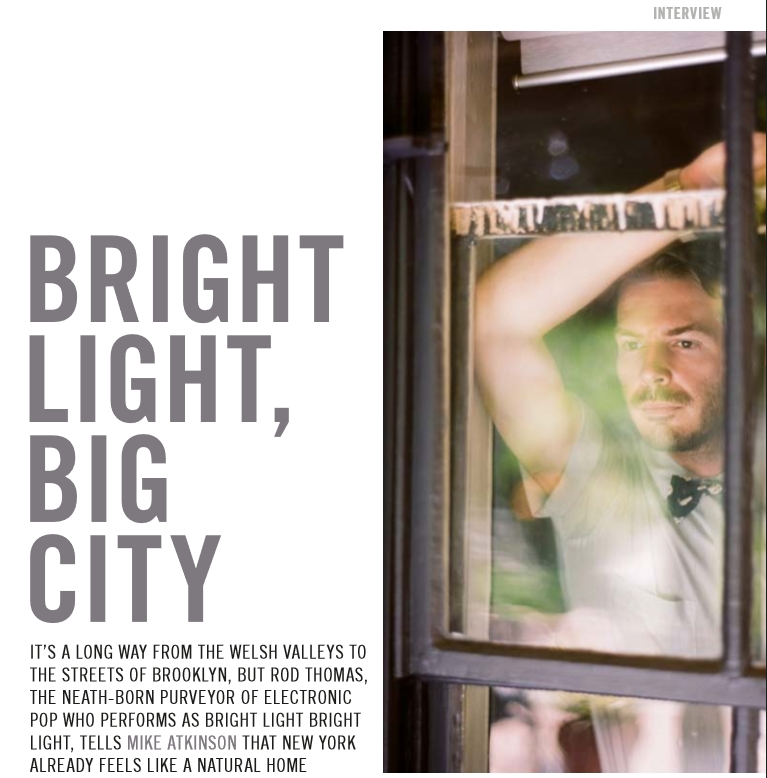
It’s a long way from the Welsh valleys to the streets of Brooklyn, but for Rod Thomas, the Neath-born purveyor of electronic pop who performs as Bright Light Bright Light, New York already feels like a natural home. “I moved over there in March 2013”, he tells me, “because I was working on my second album, and wanted a different stimulus. I’m a firm believer that the world around you and the people you interact with have a big impact on your outlook, so I thought it was a good idea to try living somewhere new.”
The album’s title, Life Is Easy, suggests a new-found contentment, but given New York’s reputation as a tough, competitive city, perhaps it shouldn’t be taken at face value. “No, my life is not easy”, Rod admits. “It’s a tongue in cheek statement. It partly refers to the idea that everyone dreams of the grass being greener somewhere else. If you go away and have an amazing time, part of that is escaping things you need to deal with, and part is being caught up in the magic and charm of being somewhere exciting and new.”
“But also, life is kind of easy”, he continues. “If you want to enjoy life, you really can. There are people with such horrendous circumstances across the world, who really make the most of life, while so much of our modern culture is based on reaching for something new, not being happy with your lot, improving, upgrading. But you can meet so many wonderful characters in your day to day life, who can change the way you look at the world.”
“There was nothing easy about moving to New York. I worked harder than I’ve ever worked in my life over the last year. It’s a hard place, but it suits me. People work hard, but they also play hard, which is how I approach my life. They make sure that when they’re not working, they enjoy this wonderful city that they have, to make it worth working that hard.”
This newly optimistic mood is reflected in the album’s subject matter, described as “a snapshot of my last year and a half”. Rod credits much of this to the friends he has made in New York, who have “brought me back from a place where I felt exhausted, and at a bit at a loss, to a place where I feel positive and excited again. The album is about taking back control, and getting to a point where I can see life for all of the wonderful things it has to offer, rather than being caught up in a slightly British mindset of moaning.”
Del Marquis from the Scissor Sisters, one of Rod’s closest friends, is heavily involved with the album, and on its lead single, I Wish We Were Leaving, another friend supplies guest vocals: Sir Elton John, who has since invited Bright Light Bright Light to support him on tour during June and July. “I wouldn’t have asked him to do it, if we weren’t friends”, says Rod. “It means more than just having a ‘featured artist’ – because what does that add, unless they mean something to the track?”
Inspired by the ending of a real-life relationship, the song examines the situation from both sides, focussing on forgiveness and acceptance, rather than the self-pity and blame of so many break-up songs. “It’s not bitter”, he agrees. “The relationship hasn’t worked out, but you don’t hate them for it. You want to hold on to what you like about them.”
The video adds poignancy to Rod’s lyrics, being filmed in one of his ex-boyfriend’s favourite restaurants. The location was suggested by the video’s directors, who had no idea of its significance when pitching the storyline. “It was a real shock”, he admits. “So I thought: well, that’s fine, I’ll go along with the treatment!”
Although Rod is an openly gay performer, and the song is undeniably about the break-up of a gay relationship, the drama is re-enacted for the video by a heterosexual couple, and there are no gender-specific lyrical references. “I thought it was quite nice to show a connection between a man and a woman”, he says, “because some people would presume I’d never think about heterosexual relationships. It’s important to see life from every perspective, which is what my whole album is about. It’s about friendships, family, and relationships: straight and gay.”
On his previous single, In Your Care, Rod tackles a theme which many gay listeners can relate to, especially those who have left home to forge a new identity elsewhere. “I’m an only child, so I feel guilty when I leave my family behind. It’s important that people back home don’t see it as a snub. The song tries to get across what is sometimes hard to say: I do think about you all the time, and you are in my thoughts. It’s a direct song to my parents.”
“I find it hard to perform In Your Care live, and I nearly cry every time I sing it. I never thought it would affect me quite so much, because I’ve sung so many songs about people who have broken my heart, and it’s never got to me on stage. But that song does, and I’m pleased, because it’s about something very real.”
“Not many gay artists have written songs about their families specifically, and I just felt: fuck it, this is probably the biggest issue that anyone I know has got with their sexuality, especially if their family are religious, or from a small town. I wanted to do something as a gay artist that wasn’t just about sex or love. It’s a different type of love. Yes, I go on stage in fucking chenille jumpsuits or whatever, but I also can be quite boring. I like to go home and have a cup of tea with my gran, because I love her very much, and I never see her, or my mother and father. Gay people very clearly have families, and it’s important that people recognise that.”
Elton John – Nottingham Capital FM Arena, Tuesday June 24
Originally published in the Nottingham Post.
Personally invited by Elton John onto this section of his world tour, Bright Light Bright Light – the alter ego of Welsh-born Rod Thomas – delivered a crisp, well received set of tuneful, heartfelt electronic pop. Elton guested on his last single, and a second album, Life Is Easy, is due out next month. “The best thing is that we get to watch Elton every night for a month”, Rod grinned, enjoying every moment of his time on stage.
Despite all the sumptuous, extravagant gloss of his celebrity lifestyle, an Elton John show is first and foremost about the music. The staging was straightforward and gimmick-free, and the performances were spirited, soulful and technically immaculate. Over the course of 26 songs and nearly two and a half hours, the 67 year-old superstar drew on material that spanned 44 years of continuing success, from his 1970 breakthrough hit Your Song to the most recent album, The Diving Board.
To mark the 40th anniversary reissue of Goodbye Yellow Brick Road, the set opened with selections from the classic double album, starting with the whole of Side One. A magnificent Funeral For A Friend/Love Lies Bleeding set the bar high, the lights coming up during its atmospheric instrumental overture to reveal the band, which included long-term collaborators Davy Johnstone on guitar and Nigel Olsson on drums. Dark suits and dark glasses were the order of the day, with a side order of glitter on Elton’s costume.
Hopping back a couple of years to the Madman Across The Water album, Levon and Tiny Dancer were early highlights, the former showcasing Elton’s piano-playing prowess with the first of many dazzling, rapturous solo breaks. This was to become a common theme for the set, as songs were extended and brought to thrilling instrumental climaxes. During these passages, the players exchanged broad smiles, nodding approvingly at each other, as if hearing each other for the first time.
A stately, mellifluous piano solo introduced Rocket Man, teasing us with its unfamiliarity before eventually cutting to the familiar opening line. The ovation at the end of the song drew Elton away from his piano for the first time, as he acknowledged our applause from each corner of the stage. This was good news for the seated punters on the left hand side, as they finally got to see more than the back of his head.
Introducing Oceans Away, written to commemorate the centenary of the First World War, Elton dedicated the song to the memory of those who lost their lives in military conflict. “Everyone who fights for freedom for us deserves our respect”, he told us. Appropriately enough, it was followed by Someone Saved My Life Tonight, another standout moment. Elsewhere, Philadelphia Freedom was so funky, that even the cameraman at the side of the stage couldn’t help jigging along.
Towards the end of Don’t Let The Sun Go Down On Me, as if summoned by an invisible signal, the punters in the front three rows surged towards the edge of the stage, ready for the final rock-out: I’m Still Standing, The Bitch Is Back, Your Sister Can’t Twist and a rip-roaring Saturday Night’s Alright For Fighting.
They stayed put for the encore: Your Song, a glorious Are You Ready For Love, and a gleefully celebratory Crocodile Rock. Reprising the first verse, Elton cheekily altered the lyric – “I remember when rock was young, Doctor Crippen had so much fun” – as Davey Johnstone mimed an axe murderer’s chop.
Blending much-loved classics with favourite album tracks from Elton’s vast catalogue, the set ranged from stripped-down balladry to blue-eyed soul and surging rock, uniting the generations and reminding us of Elton John’s continued mastery of his craft, both vocally and instrumentally. He can come back and entertain us as often as he likes. An outstanding night.
Set list: Funeral for a Friend/Love Lies Bleeding, Bennie and the Jets, Candle in the Wind, Grey Seal, Levon, Tiny Dancer, Believe, Philadelphia Freedom, Goodbye Yellow Brick Road, Rocket Man, Hey Ahab, I Guess That’s Why They Call It the Blues, The One, Oceans Away, Someone Saved My Life Tonight, Sad Songs (Say So Much), All the Girls Love Alice, Sorry Seems to Be the Hardest Word, Don’t Let the Sun Go Down on Me, I’m Still Standing, The Bitch Is Back, Your Sister Can’t Twist (But She Can Rock ‘n Roll), Saturday Night’s Alright for Fighting, Your Song, Are You Ready for Love, Crocodile Rock.
The Guardian gig venue guide: Rescue Rooms, Nottingham
The Rescue Rooms is one of the jewels in the crown of a city that punches above its weight in music venues.
Capacity: 450. Upstairs, a separate performance space (the Red Room) holds 100.
Who plays there: Critically acclaimed bands on their way up, with the odd heritage act or tribute band along the way – the likes of Rudimental, Pere Ubu, Chvrches, John Murry, Fuck Buttons, 65daysofstatic, London Grammar, John Newman, Public Service Broadcasting and Low have appeared in the past year or so.
Youthoracle – Flash Floods Vol.2 EP
Originally published in LeftLion magazine.
 As Youthoracle’s star continues to rise in the world of battle rap – he co-organised Don’t Flop’s Nottingham showcase in April, battling the league’s reigning champion – this four-track EP serves as a timely reminder of his skills as a recording artist. It’s an outspoken, socially conscious affair, pitting the MC’s fierce and furious flow against tough grime, dubstep and hip hop beats.
Hellectricity is an uncompromising opener, building from a wide-eyed ode to the wonders of nature (“the birds, the bees, the butterflies”) to an ever-accelerating blast of cold fury, so densely packed that only multiple plays will unlock its message. Just Be offers a statement of personal liberation, as Youthoracle asserts his right to be his own man, before laying into the superficialities of celebrity culture on Fake Sells. Finally, and most memorably of all, there’s the jaw-dropping, heart-stopping StoryTeller, a life story laid bare in unsparing, brutal detail.
Ronika – Selectadisc
Originally published in LeftLion magazine.
 As the title of her long-awaited début album suggests – it’s a tribute to the legendary Nottingham record store, which closed in 2009 – Ronika is a committed crate-digger, whose journeys through pop music’s past have helped to shape her direction as an artist.
She might not be the first performer to be inspired by the Eighties, but her ability to absorb and reconfigure such a wide range of the era’s key pop-dance styles, with such loving attention to detail, marks her out from the pack.
For committed fans, just over half the tracks on Selectadisc will already be familiar – from 2011’s Forget Yourself to last year’s Rough N Soothe – but there’s plenty of new material here, too. Believe It is a languid, sultry summer jam, staccato stabs punctuate the frisky What’s In Your Bag, and long-time live favourite 1000 Nights mashes Taylor Dayne with Into The Groove, to instantly memorable effect.
Katy Perry – Nottingham Capital FM Arena, Sunday May 11
Originally published in the Nottingham Post.
No one could ever accuse Katy Perry of doing things by half measures. Just over three years after her last visit, she returned to Nottingham with a stage show that was every bit as breathtakingly elaborate as before.
This was just the fourth date on Katy’s Prismatic World Tour, which she will be performing around the world from now until December, and although the staging was technically flawless, her crew took a lot longer than planned to put everything in place.
This wasn’t good news for the fans queuing outside, who were kept waiting for an extra 90 minutes, and it was even worse news for those with trains to catch at the end of the night, who were obliged to leave the venue well before the final encore. The Arena’s Twitter account was suitably apologetic, but as for La Perry herself, there was apparently no room in her script to say “sorry folks, we messed up”.
That said, the 90 minute delay had shrunk to 45 minutes by the time that Katy took to the stage, and no time-saving cuts were made to the two-hour extravaganza, which finished twenty-five minutes short of midnight. There must have been a lot of yawning in class on Monday morning, but in the grand scheme of things, it was a small price to pay.
Opening the show with Roar, perhaps her biggest hit to date, Katy emerged from a collapsing pyramid, in the centre of a massively extended triangular stage that reached more than halfway into the Arena’s standing section. In the middle of this triangle, her superfans were enclosed in a special pen, cut off from the rest of the crowd. This wasn’t perhaps the ideal vantage point, as their idol spent a lot of time at the very front of the stage, with her back turned to them – but they still looked appropriately thrilled throughout.
Setting the bar courageously high for the rest of the show, Roar featured tribal warriors with illuminated Mohicans and light spears, luminous skipping ropes, backwards conveyor belts that held the running dancers stationary – and that was before we got to the rising, rotating platforms, the high wires, the trapezes, the floating prisms, the giant teacups and all the rest of it. In the midst of this spectacle, Katy shimmied, hoofed and mugged, ever the showgirl, in a space-age crop top and matching skater skirt. The hem of her skirt and the edges of her top were also illuminated, as were the braids in her pony tail.
“We’re back”, she announced. “Let’s be in this moment, right now, together. Let’s forget about tomorrow!” Across the hall, anxious mothers checked their watches, while their daughters screamed with unrestrained delight.
While the 2011 show stuck to a carefully themed narrative, the Prismatic Tour jumped between wildly contrasting sections. For the second act, the stage turned into Ancient Egypt, as Katy reappeared on a gigantic golden horse, dressed as Cleopatra. For the third act, she returned to her alter ego, “Kitty Purry”, clad in a hot pink catsuit with matching ears, standing on a ball of wool. Towards the end of the show, dayglo and neon were the order of the day, with an early Nineties retro feel; a bra top was adorned with smiley faces on each breast, and a black and white yin-and-yang skirt rose ever higher from the stage. Elsewhere, an inflatable pink Cadillac transported the dancers along the catwalks – Nicki Minaj had one of those, too, but this was a sturdier construction – while a giant pink champagne bottle and a tube of lipstick floated around the sides of the hall.
Things calmed down for the acoustic section, giving Katy a chance to focus on her interpretative skills, on new album tracks such as By The Grace Of God and Double Rainbow. Although this did rather expose her limitations as an artist – sincerity isn’t her strongest suit – it did allow her to forge a more personal connection with her fans. “I usually don’t perspire, but my back is sweating right now”, she confessed, before reaching for a refreshing pint of beer. “Down it! Down it!”, the crowd chanted, in true Nottingham style. “I am a lady!”, she retorted, before handing most of her pint over to a grateful punter, with a word of caution: “I have a bit of a cold, so drink it – but I’ll be with you for between ten days and two weeks.”
Towards the end of the acoustic section, Katy took out her phone and called her mother, to wish her a happy Mother’s Day (in the US, they celebrate on a different date). “She has no idea, so let’s put her on speaker phone, and see what comes out of her mouth.” Mother Perry handled the surprise well, graciously wishing us all goodbye at the end of the call. It was a rare unscripted moment, and all the more entertaining for it.
Having focussed on her most recent album, Prism, for most of the show, Katy returned to some of her older hits for the finale: Teenage Dream, California Gurls, and a showstopping rendition of Firework. Alone on the stage in a voluminous multi-coloured skirt, she twirled beneath the pyrotechnics, singing her heart out, caught up in the moment, and unabashedly lapping up the experience for all it was worth. The triumph was deserved. No one else at the top of their game in contemporary pop is working it as hard as Katy Perry right now; for while Gaga and Bieber might be stumbling, she continues to reign supreme.
Set list: Roar, Part Of Me, Wide Awake, This Moment/Love Me, Dark Horse, E.T., Legendary Lovers, I Kissed A Girl, Hot N Cold, International Smile/Vogue, By The Grace Of God, The One That Got Away/Thinking Of You, Double Rainbow, Unconditionally, Walking On Air, It Takes Two, This Is How We Do/Last Friday Night (T.G.I.F.), Teenage Dream, California Gurls, Birthday, Firework.
“Gay jibes, racial slurs, and a chat at the bar: in battle rap, the rules are different.”
“There might be stringent security, but a family atmosphere prevails at Don’t Flop as the likes of Bru-C, Oshea and Ogmios trade a cappella insults in the worst possible taste.”
Outside Nottingham’s Rescue Rooms, the Saturday afternoon queue is edging forwards at a glacial pace. So stringent are the police-imposed security checks – there’s even a temporary ID scanner in the lobby – that it takes over three hours to admit the 500 ticket holders, some of whom have been queuing since mid-morning.
“Nottingham police were very suspicious of a hip hop event of this magnitude”, says Eurgh, co-founder and managing director of Don’t Flop, the rap battle league who have organised today’s event. “When they see this many tickets sold, and they hear the word “battle”, they think of people stabbing each other in the face. But it’s not what it is, and they don’t understand.”
Inside the venue, the day’s first pair of battlers, Bru-C from Nottingham and Pamflit from Manchester, are chatting amiably at the bar. Four days ago, Bru-C’s original opponent dropped out, demolishing weeks of preparation; like all contestants, he researches exhaustively, reviewing old battles and tailoring every bar for maximum personal damage. Rebuilding his routine from scratch has stretched him to the limit, but he’s hiding his nerves well.
By half past four, the main room is packed and the Don’t Flop entourage – battlers and their supporters, camera crew, assorted hangers-on – are drifting onto the stage, like teachers at an assembly. None of today’s six battles will be judged, so a relaxed atmosphere prevails. As ever, each clash will be filmed for YouTube, and performed acapella; beats were largely banished years ago, for the sake of vocal clarity.


 Mike Atkinson
leave a comment